Thank you for posting the verification.
First of all, since there seems to be a discrepancy between our definition and yours, Our definition of ”High quality” is that the background plate taken by the cinema camera and the CG rendered by HDRI match. This includes matching light source colors, exposure balance, etc. If the HDRI is properly created, the color chart shot with the background plate will match the color chart rendered with the HDRI.
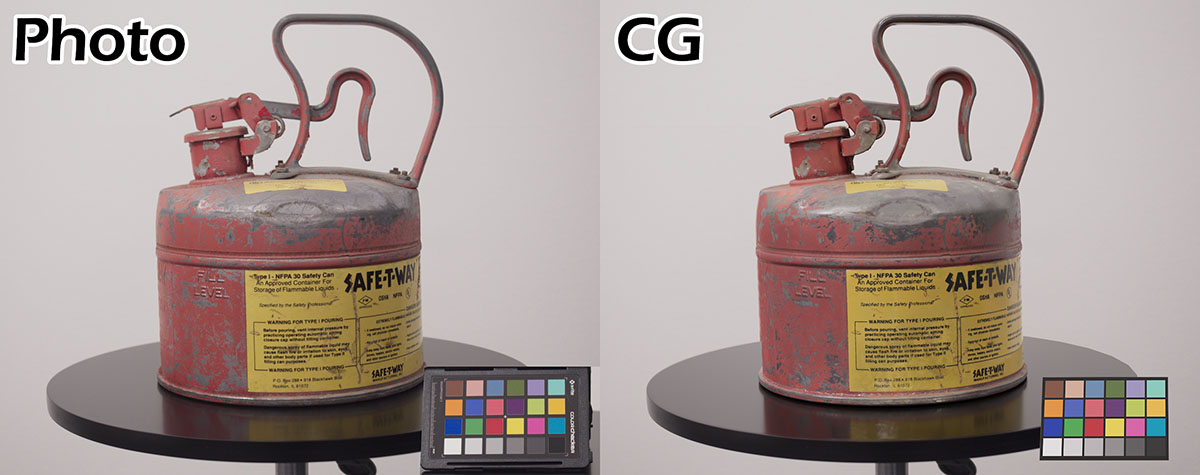
This is made more reliable when used in conjunction with Logoscope’s IDTs.
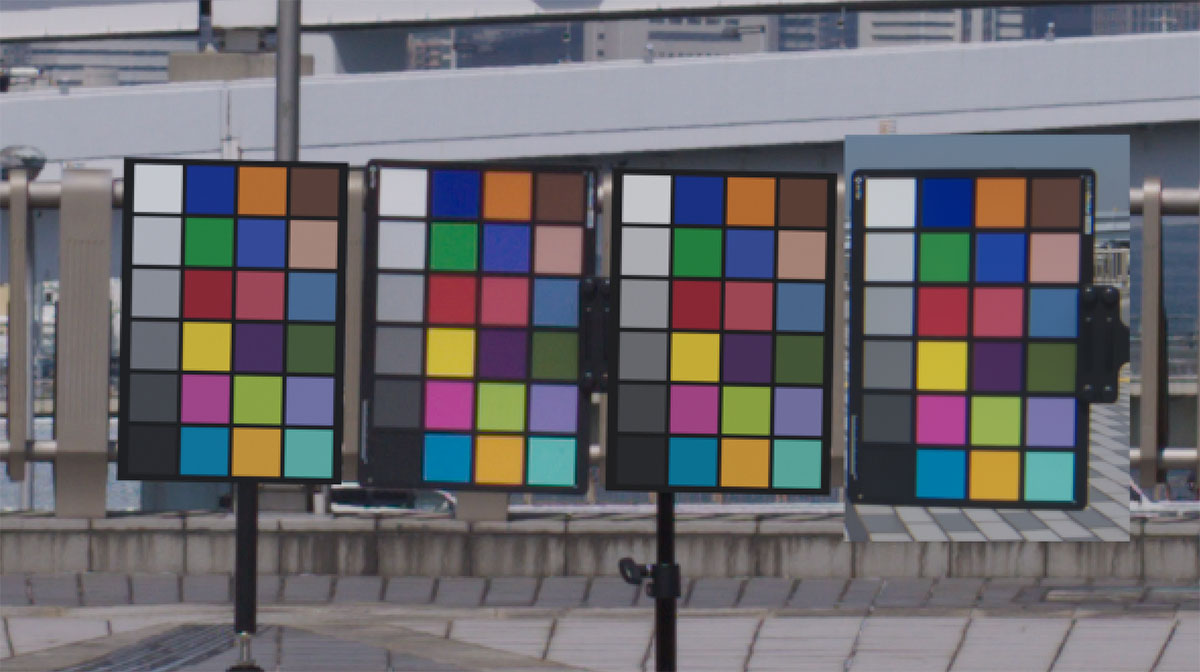
From left to right: 5D3 rendering results, 5D3 shooting images, THETA Z1 rendering results, THETA Z1 shooting images
All workflows including these IDTs are available free of charge on CGW.jp, although only in Japanese.
Now, let me tell you about the problem of using X.
When using JPEGs, it is not possible to accurately reversible tone mapping first. This is due to factors such as 8-bit tonality, JPG compression, and Gamut compression.
In addition, JPEG images contain some color correction by the camera manufacturer along with tone mapping, which cannot be simply corrected.
Of course, as has been said, it is possible to correct this to some extent by correcting the camera response curve. However, I am also aware that the HDRIs created with this method do not reach the high quality results that were initially shown.
I apologize in advance for the speculation, but it seems to me that your rendering of the CG is actually misaligned when combined with the background plate.
Of course, HDRIs created using these JPEGs can be used for lighting, so there should be no problem in checking the assets or using them in full CG productions.
However, for live-action VFX, it is important to match the plates that were photographed, and this can cause problems.
There seems to be a misunderstanding about this.
Burst-IBL-Shooter is based on automatic compensation and first includes an offset of -5EV that can be set by the API. Based on this, it takes 7 shots bracketed in +/- 3EV steps, so it can properly bracket the range required for HDRI, which is possible under Z1 specifications.
While Z1 specifications do not allow it to capture sunlight and other light sources, it can be used in most of the shooting and studio lighting environments used on many VFX shoots without any real problems.
This has also been confirmed by many VFX production companies.
The THETA X has not yet been released in Japan, and we have yet to see it in action, but we are hoping that an update will allow us to shoot in RAW, or that the next model after the Z1 will allow us to shoot even better.